

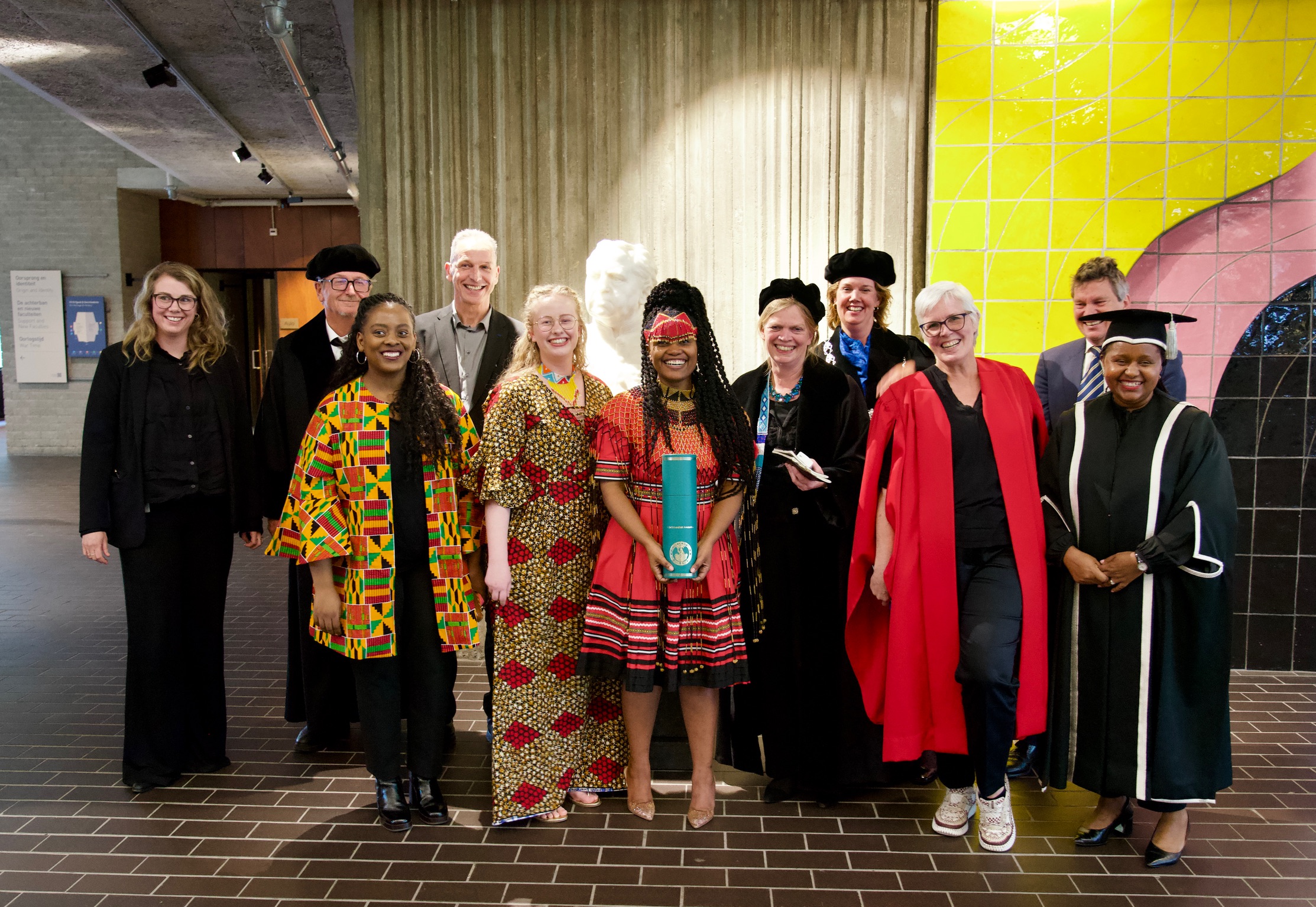
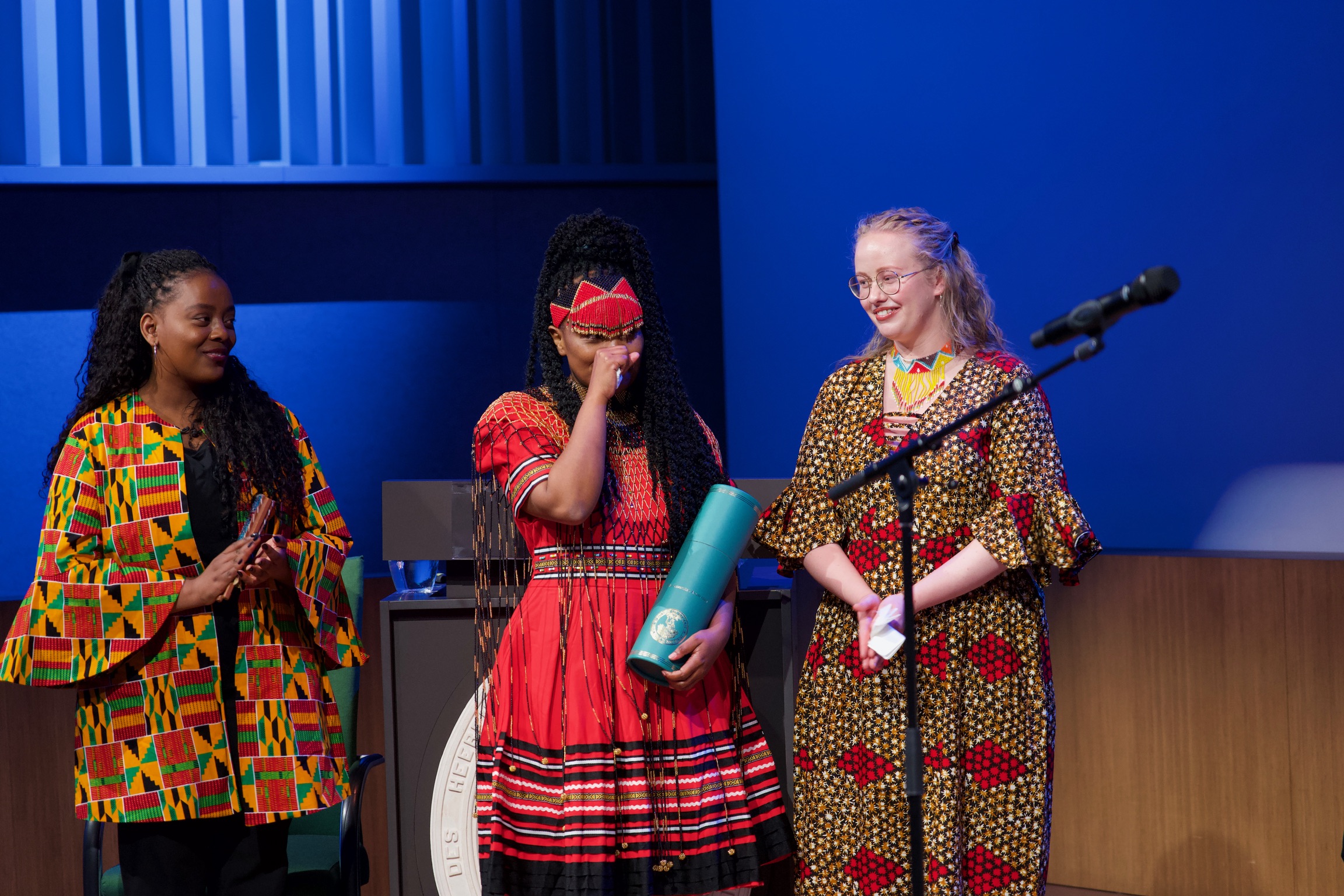
Following her viva held on 6 May 2026, Abongile Sonkosi became the first candidate to graduate with a joint doctorate between Rhodes University and Vrije Universiteit Amsterdam (VUA).
Her thesis, “Majority versus Minority: Experiences of Black Female PhD Candidates in South Africa and the Netherlands,” asks: What does it mean to belong in the academy? Physical access, she argues, is not enough. Institutional goodwill is not enough. What is required is recognition of whole persons, with their full histories, their ways of knowing, and their ways of being.
The academically rigorous and deeply moving viva was itself a testament to this argument. Abongile opened her defence with stories, the voices of her research participants woven together with those of her grandmother, offering the room an intimate window into her findings. Her five “learned opponents,” as examination panel members are known in the Dutch tradition, responded with a series of searching questions, each prefaced with an acknowledgement of how much they had learned from reading the work.
The room did not have long to wait after the panel withdrew to deliberate before they returned with the unanimous decision to award the doctorate. The certificate was signed and handed to Abongile.
What followed was the laudatio, a ceremonial address of commendation, delivered by Professor Sioux McKenna, on behalf of herself, Professor Christine Teelken and Dr Henk van den Heuvel, Abongile’s other supervisors. Speaking of the complexity of supervising a study on the experiences of Black women while being part of a supervisory team that was entirely white, Sioux indicated the need for the supervisory relationship to be two-way: “Abongile made it clear that her study participants were not data sources, they would kapha this journey with her. And in the same way, she made it clear that we, her supervision team, would travel alongside her too,” she said. “She taught me to really listen to data before reaching for analysis. She kept telling me to slow down. She deepened my understanding of African feminism, and of why feminisms that centre gender while setting aside race, class, culture and tradition are insufficient. Supervising Abongile was an education, and I am deeply grateful for her lessons,” she concluded.
The occasion was graced by a distinguished gathering of guests. Rhodes University was represented by its Deputy Vice-Chancellor: Research & Strategic Partnerships, Dr Nomakwezi Mzilikazi, alongside the VUA beadle and a representative of its Council of Deans. Also present were representatives from the Kenyan Ministry of Education, the South African Department of Higher Education and Training, the South African Council on Higher Education, Stellenbosch University, University of Nairobi (Kenya) and Maseno University (Kenya). All of these representatives were in Amsterdam as part of the EDE Project and expressed a strong interested to attend the PhD defence in order to gain insight into how an oral doctoral defence is conducted in the Netherlands, as inspiration for further strengthening and enhancing their own doctoral systems.


